


Four questions at the front door
Notes on the new forestgrove.com, and why we let Fern do the qualifying.
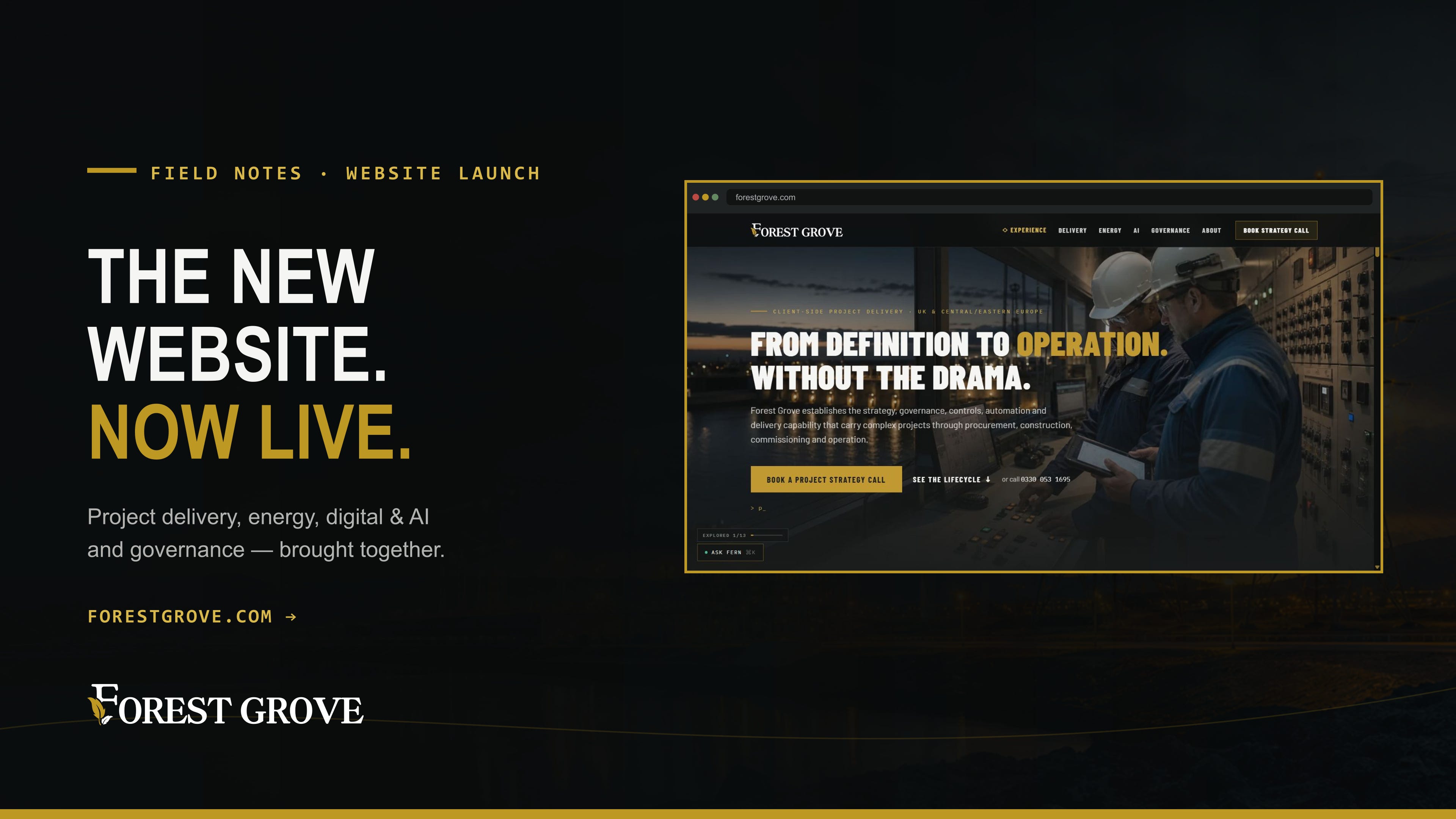
We rebuilt the Forest Grove website. Most of it is what you would expect from an infrastructure consultancy: pages for grid-scale BESS, solar and EV charging, PMO and project controls, the AI systems work. Case studies redacted harder than we would like. Along with a FAQ. There is still a normal contact page, for those who want one but our Ai does the heavy lifting and feels conversational. The design is dark and plain and light on decoration, which suits us.
None of that would justify a post. The part worth writing about sits near the bottom of the homepage, in a section called The Experience also in our header menu too. It is a small tool named Fern, and its whole pitch is one line: “Let Fern qualify the brief: four questions, straight to the right next step.” A tool called Fern at a firm called Forest Grove. The theme is not subtle.
To see why we built it, walk the standard journey on any consultancy website. You read two or three pages. You form a rough view that the firm might be relevant. Then you meet the form: name, company, email, and a free-text box inviting you to tell us about your project. You type two vague sentences, because at this stage you do not know what is worth telling. Someone replies a day or two later suggesting a call. The first twenty minutes of that call are spent extracting the information you would happily have given at the start, if anyone had asked you a decent question.
Nobody in that chain is doing anything wrong. Forms are cheap and calls are polite. But the qualification, the real work of establishing what you need and whether the firm is the right shape for it, happens late. Late is expensive for both sides. The consultancy pays for it in meetings that should not have happened. The client pays for it in a fortnight lost to scheduling.
Fern moves that work to the front of the relationship. It asks four things: the lifecycle or workflow stage you are at, what you are delivering, your main blocker, and the support model you want. That is the entire interrogation. Answer, and you are pointed at the right next step instead of a thank-you page and a promise that someone will be in touch.
Four questions is not much, and that is deliberate. The visitor we had in mind is mid-delivery and short on time. Someone trying to hold a grid connection date does not want to be warmed up with small talk by a chatty agent. They want to state their situation once and have the site respond as if it had actually listened.
Our AI systems page describes AI as “the connective layer” across preparation, procurement, construction, commissioning and operation, and pointedly “not a separate innovation theatre”. It is easy to put a sentence like that on a services page. Every consultancy has a paragraph about practical AI now. The website was the place we had to demonstrate the sentence or delete it. So the site is not a brochure with a form bolted to the back: the front end connects into the CRM, the booking system and the same kind of automation we build for clients, and Fern is the visible tip of that. When it routes you, the routing is the demonstration. When you ask for our AI services it is auto populated into a custom proposal on our back end engine. We will then add the human touch to the proposal before sending anything to you.
There is a blunt commercial reason too. Among the things we sell are AI voice receptionists that answer, qualify and book calls on their own, and automated workflows for the unglamorous middle of delivery. A prospect weighing whether to trust us with that has one free test available: check whether our own front door works this way. If our answer to “how do we start” were a plain form and a three-day email lag, those service pages would be fiction.
There is a quieter reason as well. Client-side delivery work means our case studies arrive redacted, and redacted case studies only persuade so far. When you cannot show everything you have done, how your own systems behave in front of a visitor becomes part of the evidence.
Worth being clear about what Fern is not. It is not a consultant, and it does not hand you a strategy on the spot. The site calls it a free audit, and the ordering is the point: it captures the shape of your situation before anyone starts recommending things. Diagnosis first, prescription after. That is also the order we run paid work in, so the front door is honest about what follows it.
If you run a services business, AI-flavoured or not, I think this is the transferable part. The experience layer of your website is the cheapest place you will ever get to prove an operational claim. Anyone can publish a capability statement. Wiring your own intake to behave the way you say client work behaves is harder to fake, and visitors can tell the difference without being told.
Calling a four-question flow The Experience is a grand name for something deliberately small. I can live with it. On most consultancy sites the experience is the form, and nobody names that at all.
The section is near the bottom of the homepage at forestgrove.com and bold in our header too. Answer the four questions and see where you land. If Fern routes you somewhere that feels wrong, reply and tell me where it should have sent you. I would rather have that than another form fill.